Author Archives: Kyle

My Bowels are Functional, My Spirits are High, and I Hear Drumming.

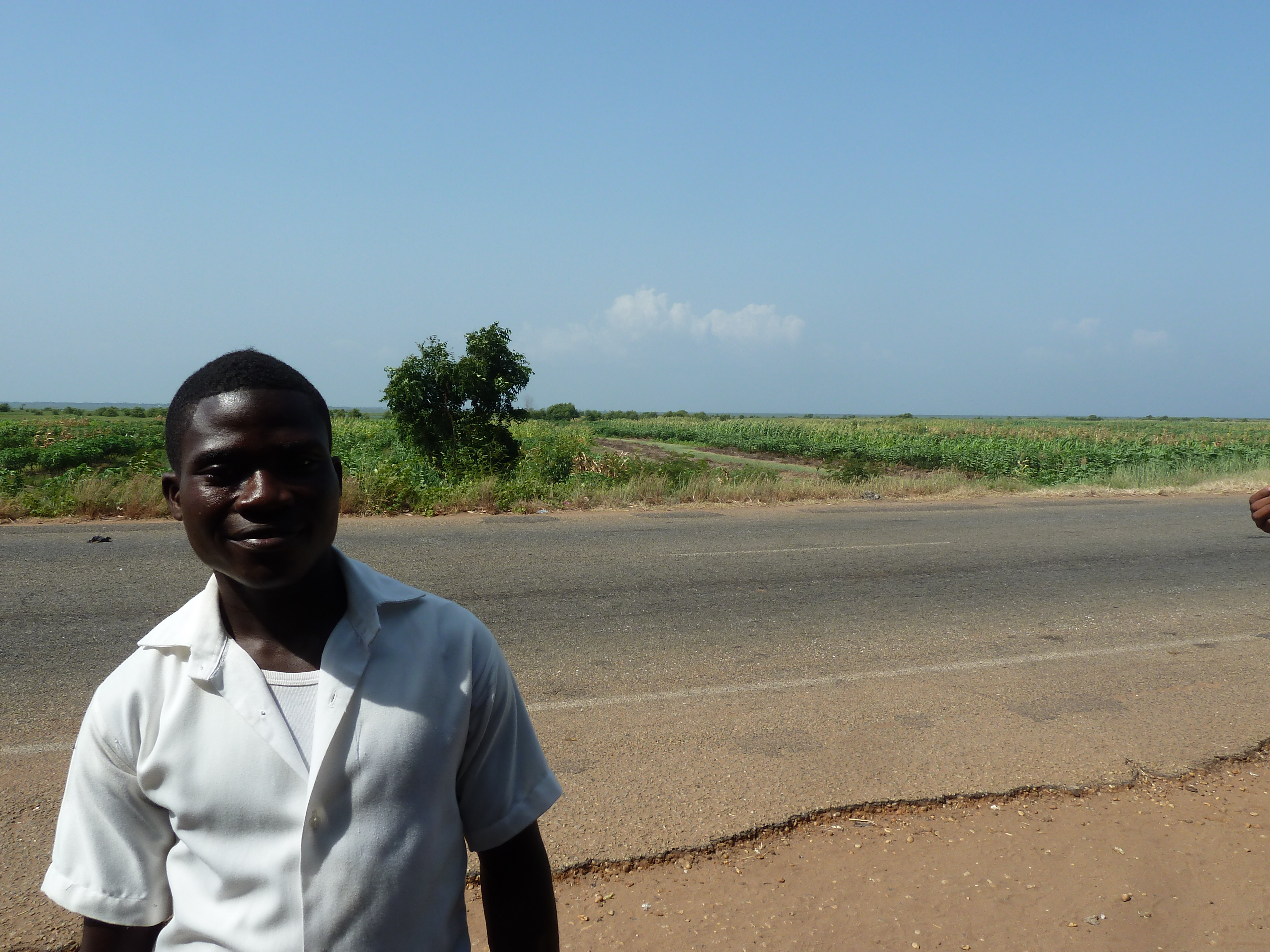
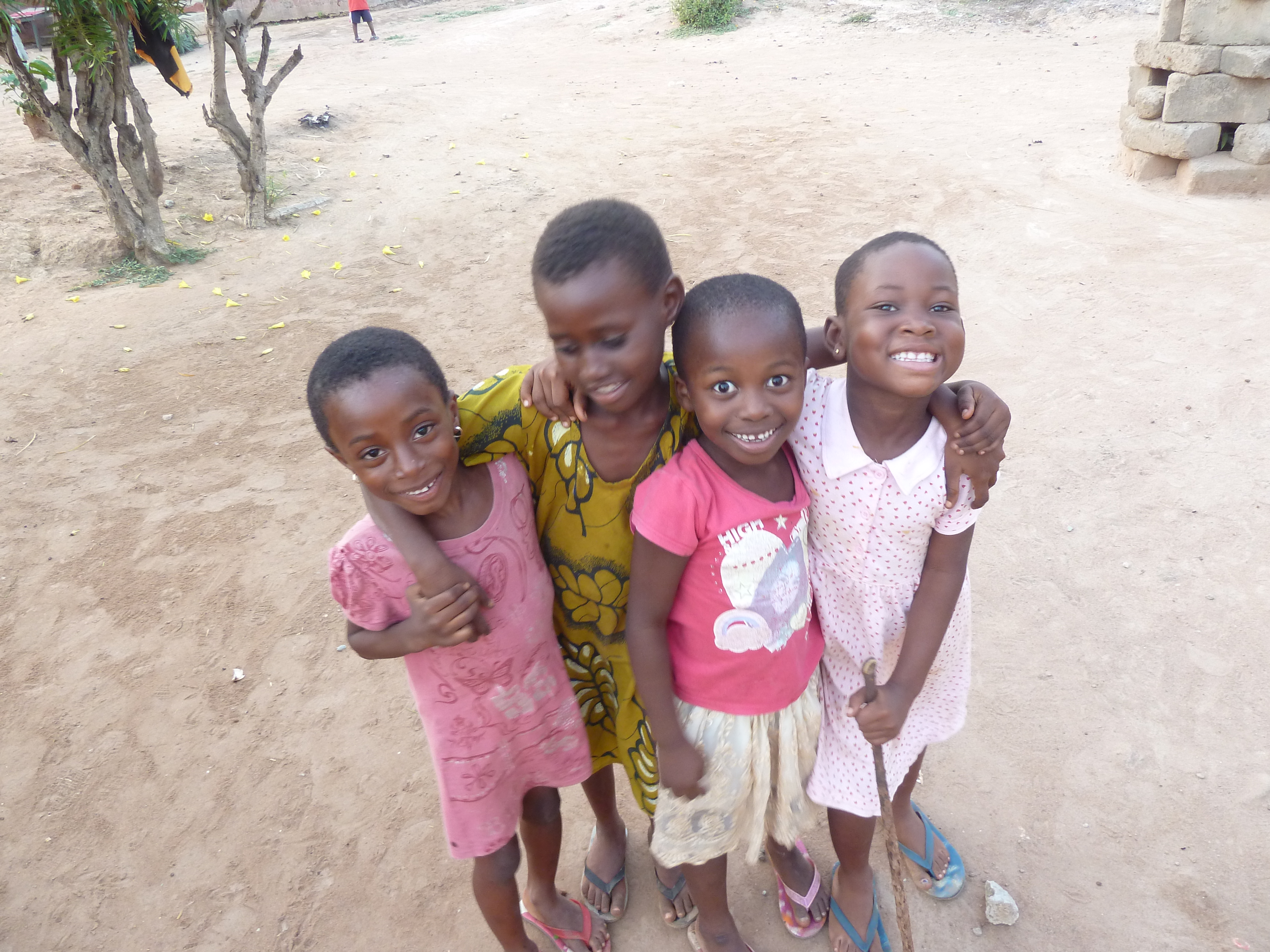
Ghanaians: always smiling except in front of a camera.

As I write this, I can hear frantic drumming in the distance. It’s soothing. Don’t get the wrong idea though. This is 21st century Africa. So far, my soundtrack has been hiplife from cab stereos, coupé décalé and kuduro in bars, afrobeat blaring from barber shops, and reggae emanating from tiny cell phone speakers. Drumming isn’t archaic, but it isn’t Africa’s only musical tradition either.

The drumming is coming from a funeral. I’ve just returned from there. Drawn by the sound, I took my flashlight and wandered about a mile through dark fields of corn. At last, I reached the house. By that point, the drumming had stopped, replaced by a DJ spinning some hiplife. Past the outdoor dance floor, in the foyer of the home, the corpse sat in a lawn chair surrounded by other chairs. Only his head was visible, the rest of his body clothed in traditional garb, his hands obscured by gloves. Behind him was a tarp that looked like a light setup for an intergalactic photo shoot. Streaks of red and orange extended toward the center where they congregated at a large orb of light. I’d like to say that I didn’t take a picture out of respect for the deceased. Really, my camera was out of batteries. Trust me, it was quite a sight.

About 15 feet away, a group of about 10 young men sat in a circle and sang songs. Aided by only a triangle and a shaker, they were participating in a sort of call and response. The subdivisions were complex, however, so it was hard to discern when one song ended and another began. The two men with instruments played a constant rhythm. I was there for an hour and a half. Throughout that time, they never stopped, and never changed rhythm.

Socialist biscuits from Anloga

Outside, a dance party was just getting started. It will last for three straight days I’m told. Except for the widow and the mother, no one seemed particularly morose. It’s an opportunity to dance, socialize with friends, and celebrate someone’s life. In this spirit, a funeral seems like appropriate closure for my stay in Anloga.

For the last five days, I’ve been staying with a family in a town in the Volta region: Anloga. I’ve been volunteering at a local school, meeting with the administration, and visiting students’ homes. My experience at the school and with the family has been mixed. I’ll save that for another post. Needless to say, however, I’ve received the same gracious Ghanaian hospitality that has come to define my experience thus far.

The town itself is gorgeous. A single road links a series of shacks hawking food, education, and Jesus. On the east side, carefully ordered plots of maize and manioc stretch for miles. Farmers plod the land in the scorching sun, their muscular shoulders glistening with sunlight. About half a mile to the east sits Keta lagoon. It’s times like this I wish I had a better camera.

Beyond the commercial stands are small neighborhoods linked by paths of sand. Homes range from palm leaf shacks to large concrete compounds. They are scattered in a way that seems to make sense to everyone except me. Wandering around, I often accidentally find myself in peoples’ front yards, backyards, and even living rooms.

One of a series of palm wine sessions with leading members of a farming community

The vast majority of residents are Ewe, which also serves as the most common language. Unfortunately, that means very little to me. Twi, Ga, Ewe or any of the tens of other languages that make Ghana so linguistically diverse are equally unintelligible to me. Though English is the official language of education and government in Ghana, one never hears it. A major language barrier exists in Accra. Here, it’s even more pronounced. Today when I walked to the beach, a young man joined me. After we greeted each other, we did not say a single word. It was futile.

Generally, when a tourist tries to learn a language, one starts with the basics: hello, thank you, I want, where is. Here, my first word is inevitably “white person.” In Twi it’s obruni. In Ewe it’s yervu (yay-voo). I hear it constantly, especially in more rural areas. It’s a playful catcall on the street, a request for a chat, a solicitation to buy something, or a warm greeting from a friend. It’s hard not to see any identification of my race as pejorative. But the word itself is innocent. Context is everything.

Ok, I need to go to bed. Off in the distance, someone’s started drumming again.  People, I’m sure, are dancing.

Some frank advice from a moto
Hey Obruni

Blessing, Benedicta and crew

I’d like to admit defeat. Those of you who fervently read my blog (all three of you) might remember how I predicted that I would never meet anyone who had never seen a white person before. Within a day I’ve already disproved myself. My first day here, I played with some neighborhood children. Their constant playful catcalls of “obruni! obruni!” were an invitation for some sloppy multilingual banter (my Twi and Ewe consist of about two words each at the moment). In the process, a child came out of one of the houses delicately balancing a toddler on her shoulder. The toddler took one look at me and burst into a fit of tears. I figured that he was either jealous of my designer shorts from Target, or that he’d never actually seen a white person before. The latter suspicion was immediately confirmed by the other children as they playfully chided me for scaring the vulnerable kid. I thought it was hilarious. I also suspect that I’m in the honeymoon phase of being a minority.

The next morning, I awoke suddenly to a chorus of roosters and goats. I looked at my watch. It was 4 am. The community’s livestock had been startled by something. All of the sudden, an amplified voice resonated throughout the neighborhood. Edem had conveniently neglected to tell me that he lived right next to a mosque. Exasperated, I thought, “I plan on doing this for four months? I thought I didn’t have to deal with this shit until Mali.”

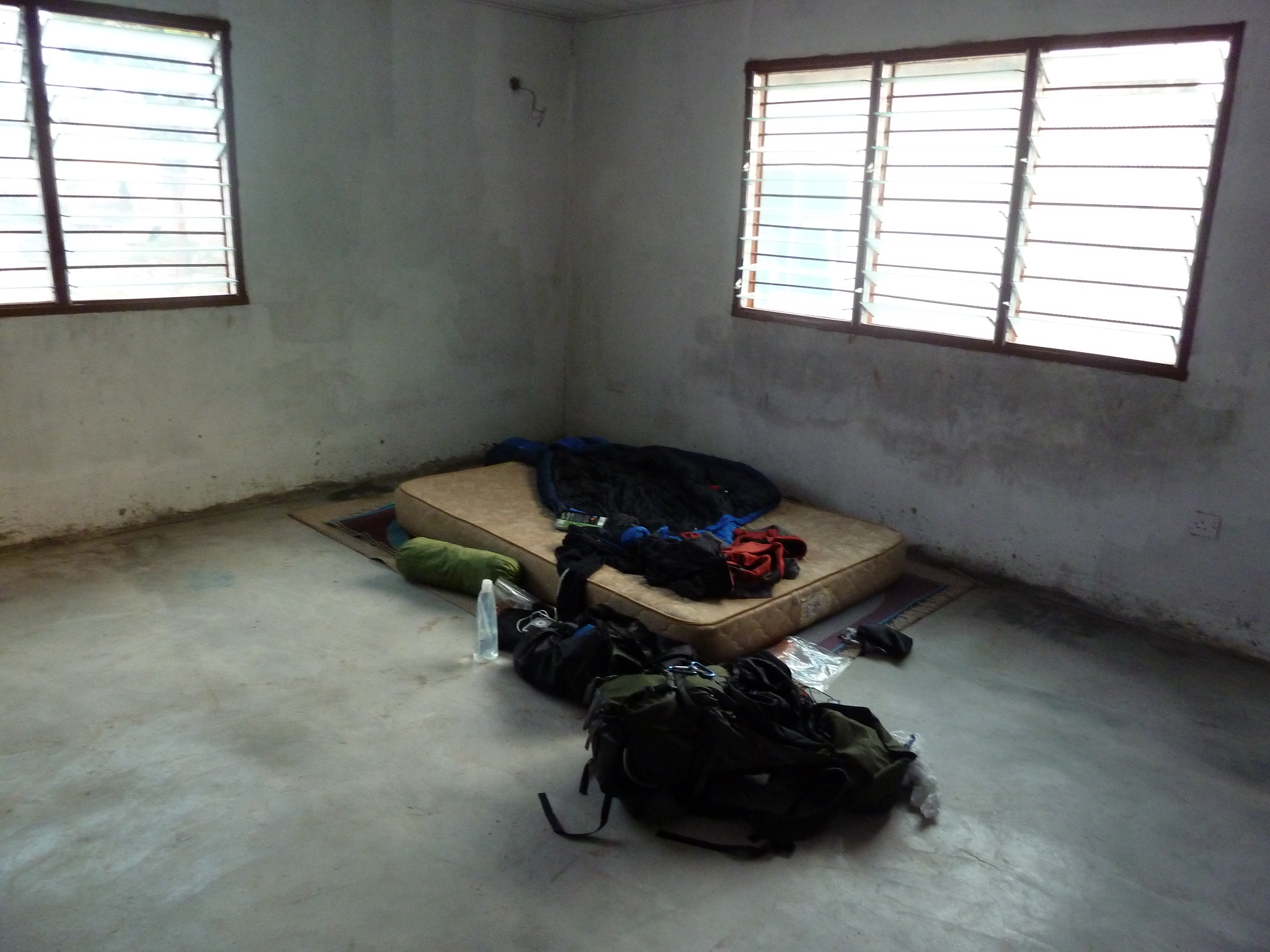
My room for now

Though it was still dark outside, the heat seemed very close to what it had been at noon the previous day. My sleeping bag was now a pool of sweat. I had only used it underneath me as a protective chaff against the bare mattress, as its intended use would have undoubtedly left me with heatstroke. I wondered whether or not I would actually be more comfortable outside, where at least the heat didn’t have an enclosed box to unforgivingly radiate. It was far too dark to take a walk, however, and the streets surrounding Edem’s home disperse into hundreds of separate dirt paths that all seem identical to me. Also, the term “street” is kind of a misnomer, since there are no street signs and none of the pathways have names. I decided to sit outside on the cement patio and wait for the sun to come up.

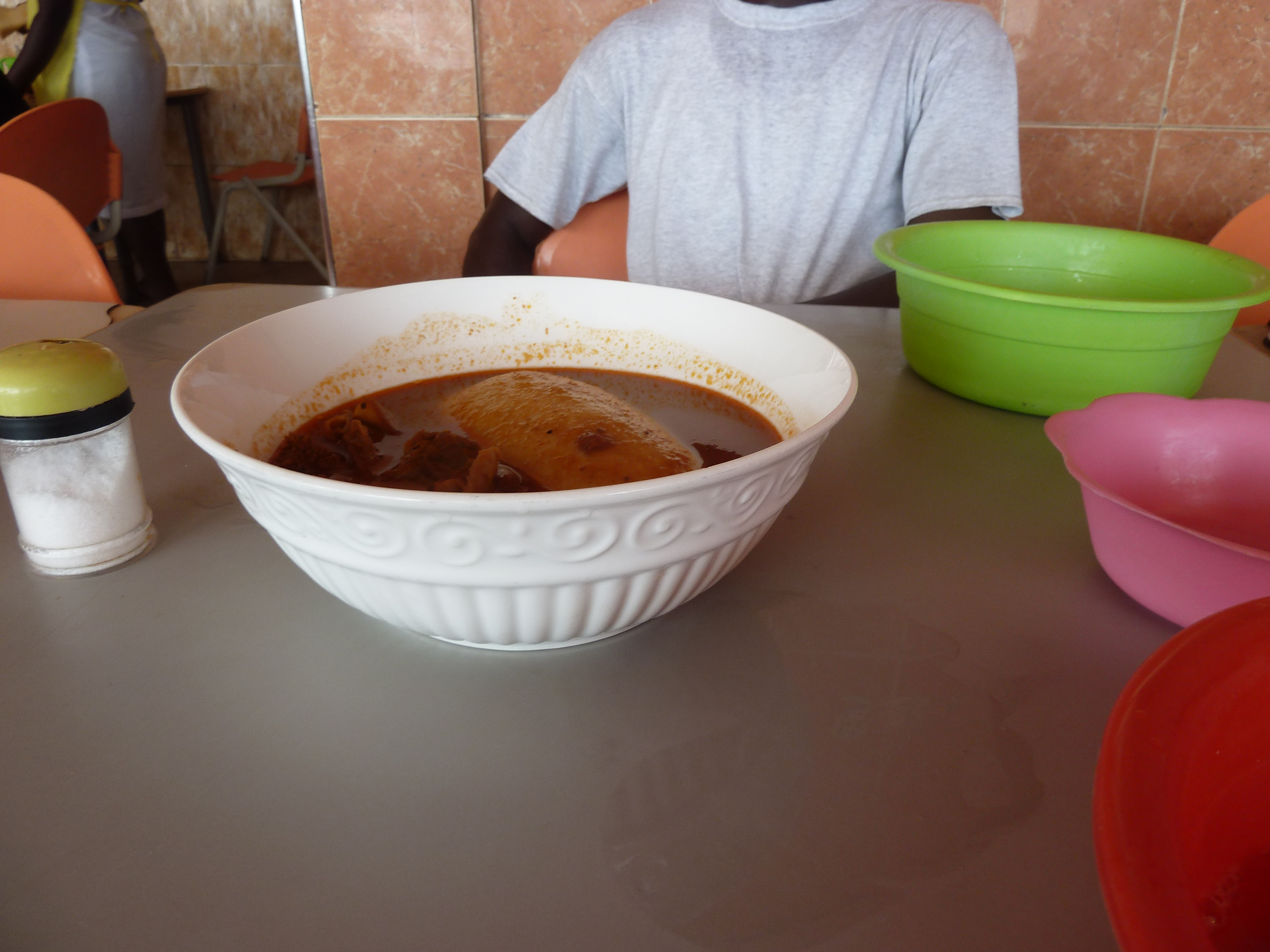
A bowl of fufu and stew

Due to jet lag, the humidity, and the cruel alarm I received at the hand of the local mosque, the next day is a bit of a blur. Edem’s friend Daniel showed me around. We eat fufu, visit Makola market, a school where his cousin works, and hang out at his house (where the aforementioned childhood trauma occurred). I take a walk around the neighborhood and am immediately approached by an elderly man with a “proposition.” Intrigued, I take him up on his offer to hold court beneath a large mango tree. Here’s his pitch: he sells merchandise to clients in Benin that he makes himself, but adorns with a “made in USA” label. He wants me to lend my American vocal talents to his project so he can appear more authentic. He promises me 20%. I weigh the pros and cons: 20% of some unknown product vs getting deported for being an accomplice to counterfeit merchandise. It’s an easy decision. Still, I have to applaud the guy for his resourcefulness. His charm quickly turns darker however, when I realize how much others in the community look down on his knavery. They ask for his name and address and seem genuinely concerned. I don’t rat him out.

Daniel outside of the school computer lab he helped build

At Daniel’s house, I meet Matthias, who besides being Daniel’s cousin, holds some hilariously misogynistic views that he’s not the least bit squeamish declaring. He also espouses some interesting generalities about “white people.” As I find myself getting defensive (on both accounts! Easy there), I think of how many people process Africans in a similar way. I give him a bye, but make sure that he knows I won’t be so kind in the future. Seemingly content, he hands me a bottled drink from his satchel. As I look at the label, the men laugh uproariously and mock me for my naiveté. The label says something in French about bottled water. The purple liquid inside was clearly not water. The bottle had been repurposed. I ask myself, “what do I care about more, protecting my vulnerable G.I. tract or appreciating this man’s hospitality?” I make a quick decision and take a sip. It’s delicious. The strong ginger stings my lips as hibiscus and other unidentifiable sweetening agents sooth the burn. Matthias, noticing my initial hesitance laughs and says emphatically, “you drink tap water in the U.S.? Then you’re fine here.” I’m too polite to correct him.

I ride home from Daniel’s house as the sun goes down. The air, as always, is dense with humidity and smoke, the landscape dotted with hundreds of kerosene lamps. The tro tro, adorned with a “respect jesus” decal, weaves manically between cars and men and women hawking various goods that rest gently on their heads. In this climate, one’s head is clearly the most effective transport vessel for goods. Giant bowls of food and water, chickens and other small livestock, toilet paper and used cell phones give new meaning to the phrase “cranial capacity.” Amazingly none of them are hit by the onslaught of traffic, even though our driver does not slow down with pedestrians literally 10 feet in front of the vehicle.

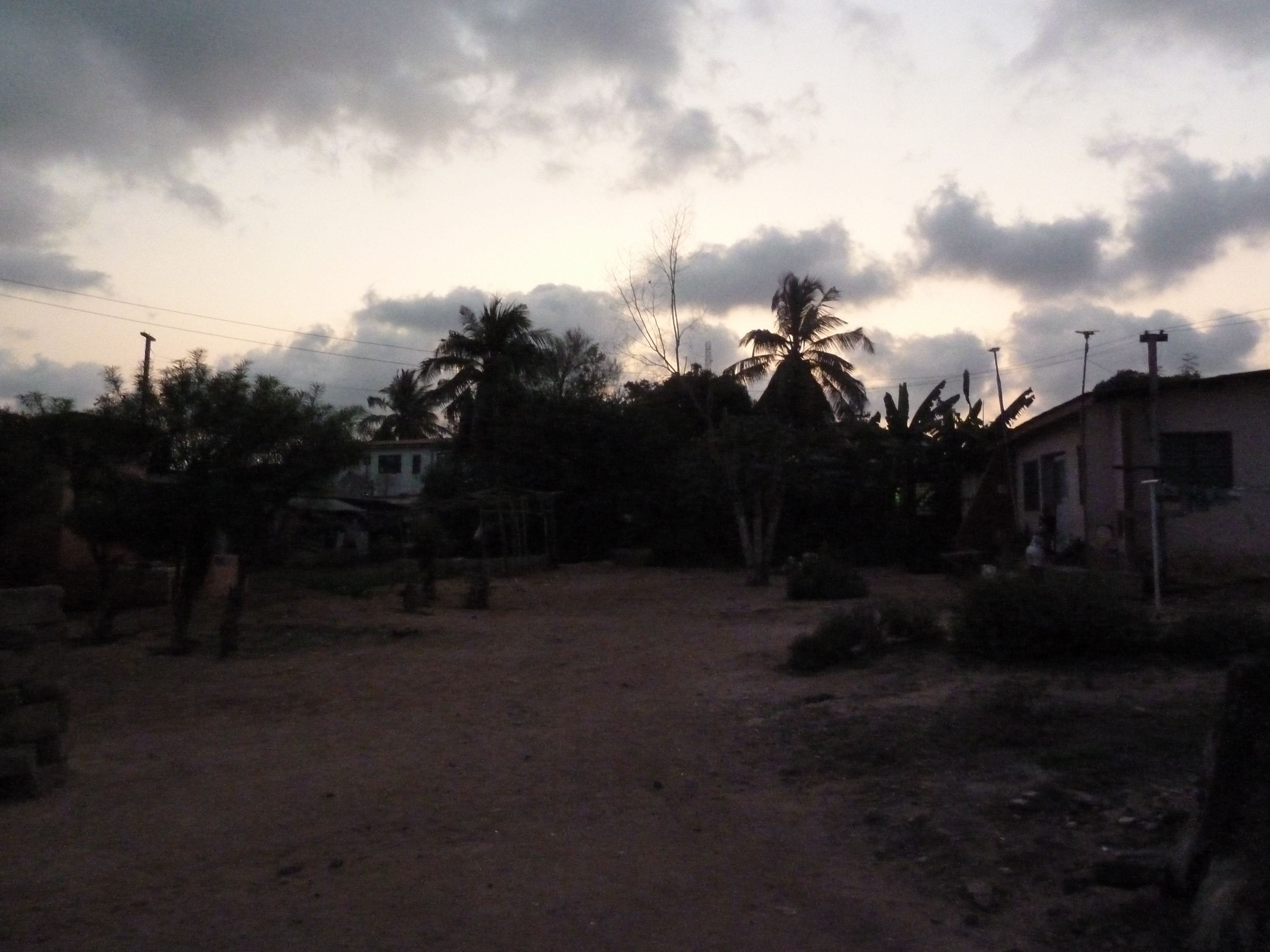
View from Edem's patio at sunset

Once I’m home, exhausted, I retire to the patio where I started the day. Edem comes out to chat. We discuss his work and cultural differences. Suddenly, he looks up. “You know you are here for a reason. God has brought you here for a reason” he says. Reflexively, I make a lame joke to soften the declaration. Edem doesn’t laugh. I’ve never seen him say anything with such conviction. He repeats it again, “God has sent you here for a reason.” Intimidated by the thought, I smile politely, say goodnight, and go to bed.

The next morning, I wake up at 4. Once again, the call to prayer reverberates warmly throughout my room. I picture hundreds of neighbors kneeling groggily by their bedsides. Satisfied, I doze off smiling.

———————————————————————————————


Here’s audio I recorded of my daily wake up call:

Why I’m Going to West Africa

Whenever I tell people I’m taking a trip to West Africa, their response generally falls into a few distinct but related categories:

  • Support: “Oh that’s really cool.”
  • Confusion: “Why on earth are you going there?
  • A well-meaning but misguided warning: “Be careful, don’t get shot or contract HIV.”
  • An attempt to relate: “Oh my cousin’s friend just got back from Zambia.”

Up until now, I haven’t really given anyone a straight answer. I’ve decided to compile a short list of reasons I specifically chose this region, both to abate future conversations and to condense my own thoughts in a formal way.

Why I’m Going:

  • The Music: I have nursed a closeted obsession with much of West Africa’s musical heritage for a good while now. This trip feels like a pilgrimage about 5 years in the making. Though I intend to make music an essential part of my voyage everywhere I go, this experience will probably serve as its musical centerpiece.
  • The People: Some of my most enriching and insightful travel experiences have come from interactions with people. In general, I’d much rather be invited into a stranger’s home than visit a museum. I see this axiom as a fundamental step towards appreciating a culture. I often find that these types of experiences are enhanced by third-world travel. That’s a huge generalization, and far from universally true. However, few would argue against the fact that barriers of personal space and privacy are often less pronounced in the third world. Meeting strangers becomes an inevitability, rather than a pursuit. Thus, coupled with its solid reputation for having some of the most hospitable people on earth, West Africa seems like an ideal location for me. It’s important to keep in mind however, that as much as I value cultural immersion, I’m still an interloper at heart. Any cultural insight I gain will come from my own unique experience, which I recognize doesn’t wholly reflect a culture’s people or values.  I hope this philosophy informs most of what I write on this blog.
  • To Challenge Myself: My West African wanderlust was in its embryonic stage when I first started planning a trip here a few years ago. I was living in Europe at the time, and the region’s proximity seemed like a good enough reason to take a jaunt south. I had only a very rough idea of where I wanted to go, yet the romantic notion of such an adventure got the best of me. I bought a one-way flight. Soon after, I developed a severe case of unrelated anxiety. It shook me to my core, and made me seriously reevaluate what I was capable of. Partially as a result, that trip got canceled and I shelved my plans. In some ways, this current trip is an affirmation of how adaptable I am and what I’m capable of.
  • Natural Beauty: Duh
  • It’s Off the Beaten Path: I can’t lie, the fact that it’s a unique place to explore influenced my decision to travel here. Of course, evading hoards of tourists is a major asset. But this is a hard one for me to cop to. Let’s be honest, the ability to smugly point out in hindsight that I’ve traveled somewhere impressive is in no way a valid reason to travel anywhere (except for maybe Antarctica or Oakland).
  • I Speak French: Well, sorta.
  • A Fervent Desire to Try Camel Cheese: Just kidding (or am I? More on this later.)

———————————————————————————————————————————————–

Why I’m Not Going:

  • To Volunteer: Many well-meaning friends and relatives stare inquisitively when I tell them I’m not going to Africa to volunteer. Of course, I do plan on doing some volunteering. I also plan on profiling aid organizations on this website. Yet these are not my primary motives, nor will they take up most of my time. There are some exceptional aid organizations doing great work in West Africa, yet the notion that Africa only merits exploration within the context of volunteerism is misguided at best. The continent suffers from a systemic image problem that I don’t intend to perpetuate.  Though I have no intentions to bury the truth, Africa has so much to offer beyond poverty, famine, corruption, warfare, and cultural oddity.
  • To “Conquer” Africa: I’m not visiting as many places as I can in a short amount of time, nor do I plan on highlighting a series of tourist sites. I don’t plan on getting my kicks by placing myself in as many dangerous situations as possible (though I’m pretty sure my mother thinks I do), and I very well may not see a single lion during the entire length of this trip. My experience will be enriched by the people I meet and the opportunities I have, not by how exciting or absurd my (mis)adventures are. I’m also not charging headfirst into anything close to uncharted territory. For the record, I think Henry Morton Stanley was kind of an asshole. I will not meet anyone that has never seen a white person before (unless I do a complete 180 and start delivering babies for an OBG-YN). Instead, I’m visiting a modernizing West Africa deeply entrenched in a rapidly globalizing economy.

——————————————————————————————————————————————————–

In short, I am about to embark on the greatest and therefore most ill-advised adventure of my life. Will I survive? You be the judge.